

More than 531,000 business applications were filed in the United States in August 2026 alone, according to the U.S. Census Bureau. U.S. Census Bureau Business Formation Statistics The interesting part is that launching a business does not necessarily require six figures, employees, or leased commercial space.
If you are wondering what business can i start with 10k, the strongest opportunities generally have three characteristics: low fixed overhead, a short path to the first customer, and the ability to start small before investing heavily.
Ten thousand dollars can be meaningful startup capital. The challenge is resisting the urge to spend all of it before proving that customers will pay you.
What $10,000 Can Realistically Buy You
A $10,000 startup budget is usually better suited to services, mobile businesses, home-based operations, specialized online businesses, and small rental companies than restaurants, retail stores, or manufacturing ventures.
The U.S. Small Business Administration recommends separating one-time startup costs from recurring monthly expenses when estimating how much capital a company needs.
That distinction matters. A $4,000 machine might seem expensive, but a $2,000 monthly storefront lease can drain the same amount of cash repeatedly.
Here are realistic starting ranges rather than promises of what every entrepreneur will spend.
| Business idea | Possible initial investment | Why it fits a $10K budget |
| Lawn/property services | 3,000–8,000 | Equipment can generate revenue repeatedly |
| Mobile auto detailing | 2,500–7,000 | No permanent shop required |
| Pressure washing | 2,000–6,000 | Relatively simple equipment model |
| Digital agency | 500–3,000 | Skills matter more than physical assets |
| Event rentals | 4,000–9,000 | Inventory can be rented repeatedly |
| Specialized reselling | 2,000–7,000 | Inventory can scale with demand |
| Cleaning service | 1,000–5,000 | Low equipment and facility requirements |
Exact costs vary substantially by state, insurance requirements, equipment quality, transportation, licensing, and whether you already own useful tools.
1. Start a Lawn Care or Property Service Business
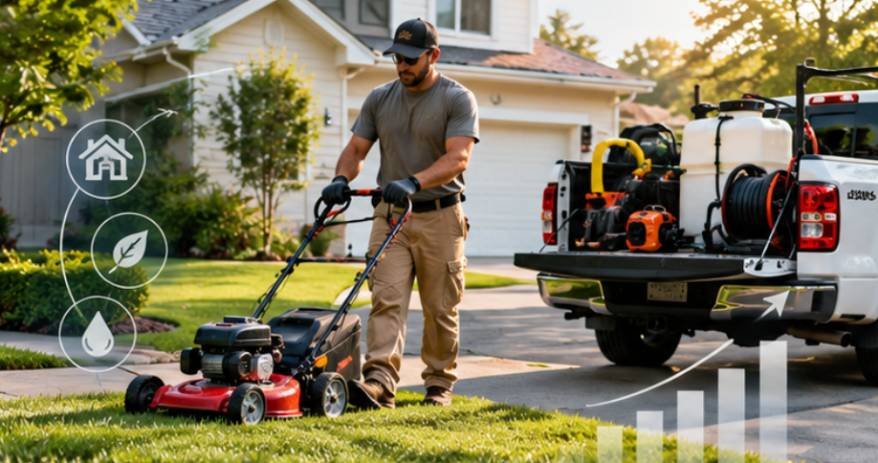
Lawn mowing, yard cleanup, gutter cleaning, minor property maintenance, and seasonal services offer an advantage that many startups lack: customers already understand what they are buying.
You could allocate money toward commercial-grade equipment, liability insurance, transportation accessories, local registrations, a simple website, and neighborhood advertising.
Better yet, begin with one narrow service. A business that starts by mowing lawns can later add hedge trimming, leaf removal, aeration, pressure washing, or snow services where climate permits.
Before buying equipment, study your local competitors and customer demographics. The SBA recommends using market research guidance to evaluate demand, market size, competition, pricing, and potential barriers before launching.
If service entrepreneurship appeals to you, it is also worth examining whether service businesses are worth starting before committing your capital.
2. Build a Mobile Auto Detailing Operation
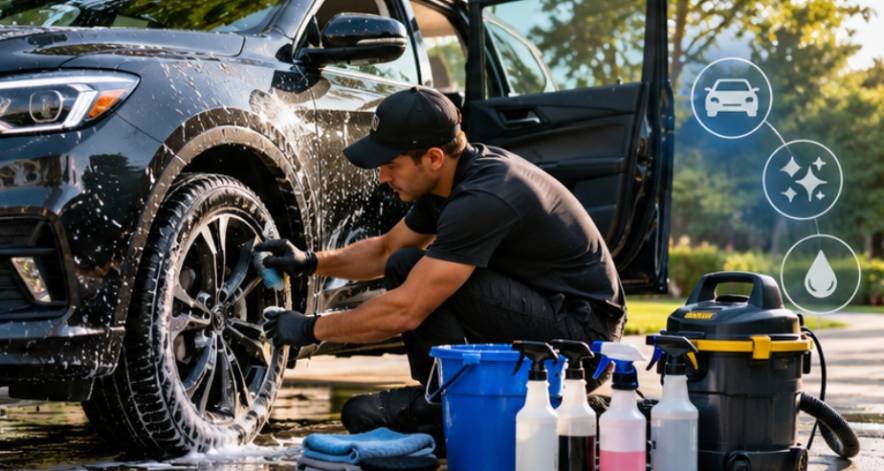
A mobile detailing company avoids one of the biggest expenses associated with an automotive business: commercial premises.
A practical setup might include a wet/dry vacuum, pressure washer, extractor, hoses, tanks where needed, brushes, towels, chemicals, insurance, and basic branding.
The economics become more attractive when equipment can serve hundreds of future jobs.
Instead of competing only on inexpensive washes, consider higher-value packages such as interior deep cleaning, stain removal, odor treatment, fleet detailing, or recurring maintenance plans.
Check municipal water-discharge rules and local licensing requirements before operating.
3. Sell a Skill Through a Freelance Agency
Someone with experience in SEO, copywriting, web design, bookkeeping, video editing, paid advertising, email marketing, or social media may not need anywhere near $10,000 to begin.
That is an advantage, not a reason to spend more.
A small agency can use its budget for a professional website, software, contracts, insurance where appropriate, targeted prospecting, and several months of operating runway.
For example, imagine spending $1,500 setting up the business and retaining $8,500. If monthly software and marketing expenses total $700, you have considerably more time to secure recurring clients than someone who spent the full $10,000 on launch day.
4. Start a Residential or Small-Office Cleaning Company
Cleaning remains attractive for limited-capital entrepreneurs because basic equipment is comparatively inexpensive and customers can become recurring accounts.
Start with a clearly defined market rather than advertising yourself as a cleaner for everyone. You might focus on residential recurring cleans, move-out cleaning, vacation rentals, or small professional offices.
The opportunity depends heavily on local pricing and labor economics. If you eventually hire workers, payroll, workers’ compensation requirements, training, transportation, and scheduling become far more important.
5. Create a Small Event-Rental Business
Instead of providing labor every time you earn money, a rental business allows an asset to generate revenue repeatedly.
With $10,000, a home-based operator might begin with folding tables, chairs, linens, backdrop equipment, portable décor, yard games, or another narrow category.
Do not buy a warehouse full of inventory immediately. Start with products that local customers repeatedly request, track utilization, and reinvest profits into additional units.
Storage and delivery are the hidden costs. Someone with garage space and a suitable vehicle has a very different cost structure from an entrepreneur who needs rented storage and delivery help.
6. Try Specialized E-Commerce or Reselling
Ten thousand dollars is enough to test a focused product business, but inventory introduces more risk than service businesses.
Avoid investing $8,000 in merchandise simply because a product appears popular online.
Begin with small quantities, test pricing, calculate shipping and marketplace fees, and measure how quickly inventory sells. Specialized replacement parts, hobby supplies, collectibles, refurbished goods, and hard-to-find niche products can sometimes offer more defensible opportunities than generic merchandise.
Cash sitting in unsold inventory cannot pay next month’s bills.
7. Launch a Pressure-Washing Business
Pressure washing illustrates why equipment-based local services work well at this budget level.
An entrepreneur can purchase professional equipment without carrying the fixed costs of a traditional storefront. Residential driveways, patios, sidewalks, fences, and certain commercial properties can create multiple customer segments.
Training matters. Incorrect pressure, chemicals, or techniques can damage siding, roofing materials, paint, landscaping, or masonry.
Budget for education and insurance rather than viewing equipment as your only startup expense.
Use the 50/30/20 Test Before Spending Your $10K
A useful starting framework is:
50% for the revenue engine
Put roughly $5,000 toward equipment, essential inventory, registrations, insurance, technology, or whatever actually allows you to deliver the service.
30% for customer acquisition and operations
Reserve about $3,000 for your website, local advertising, software, fuel, supplies, payment fees, and early operating costs.
20% untouched
Keep approximately $2,000 as emergency working capital.
This is not a universal accounting rule. Some businesses should maintain an even larger reserve. SCORE’s startup-expense guidance recommends building contingency money into projections and notes that entrepreneurs commonly use roughly 10%–20% as a cushion for unexpected costs. SCORE startup expenses worksheet
Test the Business Before Buying Everything

If you are still deciding what business can i start with 10k, run a simple validation test.
First, identify 20 potential customers. Then learn what they currently use, what the problem costs them, and what they dislike about existing options.
Next, try to secure actual interest—a booked appointment, deposit, signed proposal, preorder, or another meaningful commitment.
A customer saying, “That sounds like a great business,” is not validation. Someone agreeing to pay is.
Run your numbers before launching:
Monthly break-even sales = fixed monthly costs ÷ contribution margin percentage
The SBA provides a break-even framework that separates fixed expenses from costs that rise with each sale
Do Not Forget the Administrative Side
Your business structure affects taxes and filing requirements. The IRS identifies sole proprietorships, partnerships, corporations, S corporations, and LLCs among the common structures entrepreneurs use.
Depending on the business, you may also need state registration, local permits, insurance, sales-tax registration, or industry-specific licenses.
Before investing in equipment or opening your doors, review what licenses you need to start a business to identify the registrations, permits, and industry-specific requirements that may affect your startup budget.
An Employer Identification Number may also be necessary in certain situations. The IRS issues EINs directly at no charge.
Do not spend thousands incorporating complicated structures before understanding what your particular business requires.
Avoiding premature spending is one of several ways to sidestep common mistakes new business owners make in the first year.
Frequently Asked Questions
1. What business can I start with $10K and run alone?
Cleaning, lawn care, mobile detailing, pressure washing, freelance marketing, bookkeeping, web design, and specialized reselling can all begin as owner-operated businesses.
2. Is $10,000 enough to start a profitable business?
It can be. Profitability depends more on demand, pricing, margins, operating expenses, and customer acquisition than on spending the entire $10,000.
3. Should I spend all $10,000 when launching?
Usually not. Keeping working capital available gives you room for marketing, repairs, supplies, slow sales periods, and unexpected expenses.
4. Which $10K business has the lowest overhead?
Skill-based freelance businesses typically have the lowest startup overhead because they require little inventory, equipment, or commercial space.
Start With Customers, Not Equipment
Ten thousand dollars is enough money to make a serious start, but it is also enough money to waste surprisingly quickly.
I would choose the business where I can verify demand before committing most of the capital. Talk to customers, study competitors, estimate break-even sales, make a few real offers, and then buy what the business actually needs.
The smartest answer to what business can i start with 10k is rarely the idea with the most impressive equipment. It is the one that can turn the first few thousand dollars into paying customers while leaving enough cash to survive long enough to grow.