
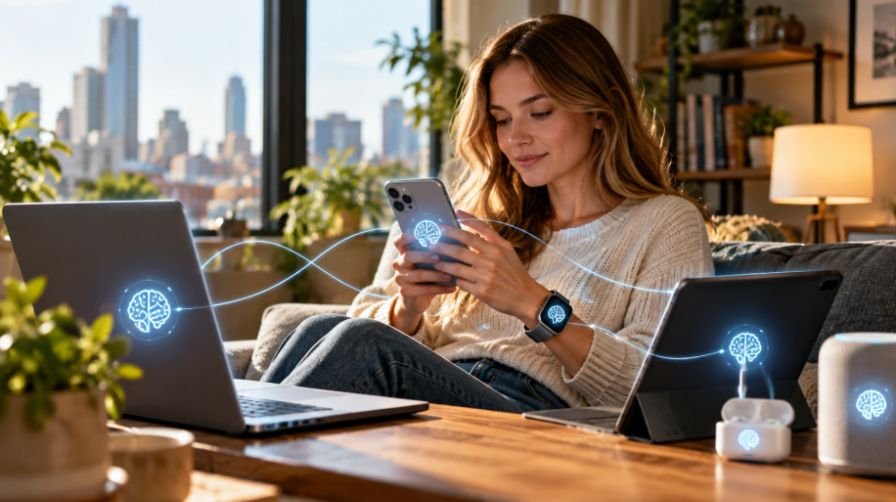
I started noticing the shift when AI features stopped feeling like separate tools and began appearing inside the devices I already use. A phone can clean up a photo, summarize information, translate speech, or respond to a request without always feeling like it is waiting for a distant server. The interface remains familiar, but the intelligence underneath it has changed.
I also found that the most useful part of local AI is not necessarily having a chatbot in my pocket. It is the quieter stuff: faster responses, better awareness of context, and features that keep working when a connection is weak. Newer chips built for AI make the shift more practical.
What On-Device AI Actually Means
On-device AI means an AI model performs inference directly on consumer hardware rather than sending every request to a remote cloud service. The device might use its CPU, GPU, or, increasingly, a Neural Processing Unit, or NPU, to process information locally.
A keyboard predicting the next word, a camera recognizing a subject, or software transcribing speech can all use local inference. Cloud computing remains valuable for complex reasoning and larger models. The shift is toward deciding where each task should happen instead of assuming everything belongs in the cloud.
Speed, Privacy, and Reliability Are Driving the Shift

Latency is one of the clearest advantages. A cloud request has to travel across a network, reach a server, be processed, and return a result. Local inference removes that round trip. For translation, voice processing, image analysis, or accessibility features, even small delays can make interactions feel less natural.
Privacy is another major factor. When processing stays on a device, certain personal information does not need to leave it. Local processing can reduce how much sensitive information needs to be transmitted.
Reliability matters, too. A locally running model can continue working when a user is on a plane, underground, traveling through a weak coverage area, or dealing with an unreliable connection. It cannot make every AI feature independent of the internet, but it can keep some functions available when connectivity disappears.
For connected devices that depend on stable network access, knowing how to fix Comfast extender that keeps rebooting itself can also help restore reliable connectivity when repeated device restarts interrupt the connection.
NPUs Are Changing What Consumer Devices Can Handle
The hardware story is just as important as the software. Modern processors increasingly include NPUs, specialized accelerators designed to handle AI calculations efficiently. A device can distribute AI tasks to silicon built for sustained machine-learning operations.
NPUs can also improve battery efficiency. AI workloads can consume substantial power, so specialized silicon makes local inference more practical in thin laptops, phones, and other battery-powered products.
AI PCs show how quickly this approach is spreading. Windows supports local AI models and NPU acceleration, while consumer processors increasingly advertise dedicated AI performance. AI capability is becoming part of device architecture rather than an add-on.
AI Becomes More Useful When It Knows the Device
Local intelligence also creates opportunities for more contextual software. A device already knows what is happening around it, such as the photo being edited or the words being dictated. Processing some of that context locally can make interactions feel more personal.
That is where the rise of proactive digital assistants becomes particularly interesting. An assistant that can understand local context does not always have to wait for a carefully worded prompt. It could help organize information, surface relevant actions, or respond to signals from several device functions. An assistant may eventually feel less like a chatbot and more like intelligence woven into the operating system.
For consumers, that can matter more than model size. A smaller model that responds instantly may be more useful than a larger one that needs a constant connection.
Cloud AI Is Not Going Away
On-device AI has limits. Larger models require more memory and computing power, and some tasks benefit from enormous context windows or advanced reasoning that a phone or laptop cannot efficiently provide. Sending those workloads to powerful servers remains sensible.
That is why the future is likely to be hybrid rather than entirely local. A device can handle quick, privacy-sensitive, or offline tasks while handing more demanding requests to cloud infrastructure. Apple’s current AI architecture illustrates this approach, using on-device models when possible and Private Cloud Compute for requests that need additional processing power.
Software can therefore evaluate a task and route it to the most appropriate place.
What This Means for Everyday Consumer Technology
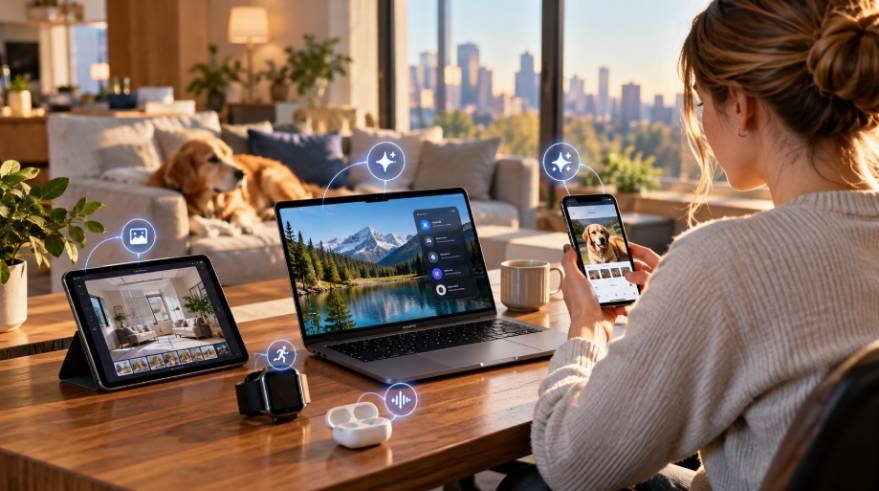
The biggest change may be less visible than another AI app. Phones, laptops, watches, earbuds, cameras, and other products can increasingly treat AI as a built-in capability.
As more connected devices become part of everyday routines, straightforward setup and reliable connectivity remain important; even something as practical as Wavlink setup can determine how easily a consumer device gets connected and ready to use.
That could mean faster transcription during a meeting, smarter photo searches, live translation while traveling, improved accessibility tools, or an assistant that can act across several applications. When intelligence is available locally, developers can design features around continuous interaction rather than occasional requests.
These improvements can be particularly useful for people who want technology to feel simpler and more accessible, making easy tech tips for seniors at home increasingly relevant as everyday devices become more capable.
Local inference can also reduce dependence on cloud processing for suitable workloads. That gives manufacturers another reason to build better AI hardware, while consumers may increasingly judge devices by AI performance alongside battery life, cameras, and speed.
The Habits Worth Keeping
The move toward on-device AI is ultimately about putting intelligence closer to the moment when people need it. Faster responses, stronger offline capability, and more private handling of personal context can make AI feel less like a remote service and more like a natural part of a device. The cloud remains essential for demanding workloads, but it no longer has to carry every interaction.
The transition is happening quietly. The next useful AI feature may simply make a familiar device faster and more helpful without asking users to think about where the processing happened.
Frequently Asked Questions
1. Is on-device AI the same as edge AI?
They overlap, but they are not identical. On-device AI specifically means processing happens on the user’s device. Edge AI is broader and can include processing on nearby gateways, cameras, vehicles, or other edge hardware.
2. Does on-device AI work without internet access?
Some features can. If the required model and software are stored locally, inference can continue offline. Cloud-dependent features still need a connection.
3. Are NPUs necessary for on-device AI?
No. AI can run on CPUs and GPUs, too. NPUs are specialized for many AI workloads and can improve efficiency, particularly on battery-powered devices.
4. Will cloud AI disappear?
No. Cloud systems remain better suited to many large, complex, and compute-intensive workloads. Consumer devices are increasingly using a combination of local and cloud processing.