

For years, I believed visual learning meant rewriting neat, pastel-highlighted summaries. That habit cost me hundreds of wasted hours and mediocre exam grades. Passive review creates a dangerous illusion of competence because recognizing a diagram is not the same as reconstructing it under pressure. Implementing dedicated active recall study methods for visual learners completely transformed my academic performance by swapping passive recognition for high-friction spatial retrieval.
When you force your brain to pull complex visual architecture out of thin air, neural pathways lock in. The secret lies in turning abstract text into structured graphics, spatial layouts, and high-contrast diagnostic blurts.
Why Traditional Retrieval Fails Spatial Thinkers
Standard retrieval advice usually targets auditory or verbal learners. Most study guides tell you to recite definitions aloud, hide paragraphs with index cards, or write text-heavy summaries. When I tried those methods, my retention flatlined. My brain does not file concepts as sentences; it stores them as interconnected spatial networks, flows, and dimensions.
+———————————————————————-+
| DUAL-CODING RETRIEVAL MODEL |
| |
| [ Verbal Trace ] <— Integrated Linkage —> [ Non-Verbal Imprint ]
| (Terminology, (Spatial Map, |
| Equations) Color Contrast) |
| │ │ |
| └────────────────► [ Long-Term ] ◄────────────────┘ |
| Memory |
+———————————————————————-+
Dual-Coding Theory Meets the Testing Effect
Cognitive psychologist Allan Paivio established dual-coding theory, showing that the human mind processes verbal and visual cues through distinct, parallel channels. Research published by the National Center for Biotechnology Information confirms that engaging both channels dramatically improves associative memory performance.
When you pair dual-coding with the testing effect—extensively documented by the American Psychological Association—retention multiplies. Combining deliberate retrieval with spatial cues prevents mental fatigue while accelerating recall speed under strict exam constraints.
Visual Active Recall Strategies That Actually Work
Over the past four years of testing different study routines, I distilled visual retrieval into four reliable, high-yield frameworks.
1. The High-Contrast Whiteboard Blurt
Blurting is one of the most effective retrieval techniques available, but standard text blurts often fall short for spatial thinkers. I use a multi-marker visual hierarchy on an unruled dry-erase board:
- Pick a single central anchor concept and close all study notes.
- Using a single black marker, reconstruct every branch, taxonomy, formula, and flow chart purely from memory.
- Open your reference textbook to cross-check accuracy.
- Without erasing your mistakes, draw every missing connection and correct every mislabeled node using a vivid red marker.
The stark visual clash between the black baseline ink and the red correction marks acts as an immediate diagnostic snapshot. Your eyes register exactly where your structural logic fractured.
2. Digital Image Occlusion and Spatial Anchoring
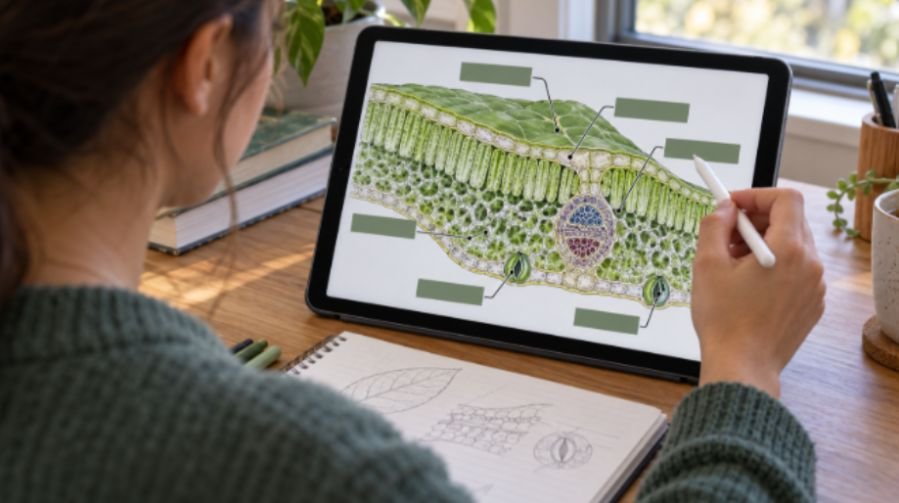
Traditional flashcards present a prompt on side A and a wall of text on side B. That layout strips away relational context. Digital image occlusion solves this disconnect by hiding specific labels inside a complete, intact visual system.
Using open-source software like Anki, take high-resolution diagrams of biological pathways, anatomical models, or mechanical schematics, and mask individual labels with opaque rectangular blocks. When the card appears, your task is to retrieve the hidden term while evaluating its structural relationship to the visible surrounding elements.
For physical study spaces, I mirror this concept by assigning specific card categories to exact physical zones across my desk. Remembering that a concept was anchored to the top-right corner provides an extra spatial retrieval hook during test day.
3. Skeleton Concept Map Reconstruction

Instead of drawing an entire system from scratch every session, create empty structural templates:
| Mapping Phase | Visual Component | Operational Action |
| Scaffolding | Empty boxes, arrows, branches | Draw the relational framework without text |
| Retrieval | Node entries and formulas | Fill in every concept purely from memory |
| Diagnostic | Broken link analysis | Identify relational gaps using contrasting ink |
This strategy forces you to evaluate relationships rather than isolated facts. It works particularly well for multi-tiered systems like cellular respiration, economic supply chains, or historical cause-and-effect networks.
4. Picture-to-Text Transduction Drills

Transduction requires converting information from one sensory format into another. Study a dense technical chart, graph, or infographic for two minutes. Close the book, take a blank sheet of paper, and translate that visual pattern into a structured procedural summary.
Next, reverse the process. Take an essay prompt or dense block of theory and force yourself to synthesize the core mechanics into a standalone visual icon or infographic without writing complete sentences. This forces deep semantic processing, ensuring you master the underlying mechanisms rather than memorizing surface wording.
Integrating Retrieval Practice With Your Note System
Active recall works best when fed by well-organized primary sources. If your initial notes are messy walls of unformatted prose, extracting clean visual hierarchies becomes an uphill battle.
Learning how to take Cornell notes for college lectures gives your study sessions immediate spatial structure. The dedicated recall cue column on the left naturally converts into an active self-testing checklist during revision.
For independent learners, open educational resources for independent adult learners can provide additional textbooks, courses, lectures, and reference materials to build those structured study sessions without relying entirely on traditional classroom resources.
The 14-Day Visual Spaced Revision Protocol
Retrieval practice is incomplete without disciplined spacing. Spaced repetition prevents the Ebbinghaus forgetting curve from erasing your progress. Group your syllabus topics into four distinct modules and rotate them across this two-week schedule:
Week 1:
Day 1: Module A (Whiteboard Blurt + Red Diagnostic)
Day 2: Module B (Whiteboard Blurt + Red Diagnostic)
Day 3: Module C (Blurt) + Module A (15-min Speed Skeleton)
Day 4: Module D (Blurt) + Module B (15-min Speed Skeleton)
Day 5: Synthesis Day (Image-Occlusion Flashcard Decks: A & C)
Day 6: Module C (15-min Speed Skeleton) + Module D (15-min Speed Skeleton)
Day 7: Interleaved Systems Map (Connect Module A to Module B)
Week 2:
Day 8: Interleaved Systems Map (Connect Module C to Module D)
Day 9: Practice Exam Questions targeting Module A & B red-ink errors
Day 10: Practice Exam Questions targeting Module C & D red-ink errors
Day 11: Rapid-Fire Image Occlusion Drills (All Decks)
Day 12: Modules A & B (10-minute Blind Skeleton Maps)
Day 13: Modules C & D (10-minute Blind Skeleton Maps)
Day 14: Comprehensive Cross-Topic Master Map (Zero Books Open)
Sticking to this 14-day cadence ensures you revisit each core visual framework right as your memory begins to fade, cementing structural recall over the long term.
Researching the best ways of taking notes will show that incorporating structural sketches, split tables, and visual margins cuts your revision prep time in half. Build visual recall cues straight into your notes during the lecture itself so your study materials are primed for testing later on.
Frequently Asked Questions
1. How do I use active recall for visual subjects without drawing skills?
Use basic geometric boxes, directional arrows, and rough stick figures, as cognitive retrieval relies on spatial structure rather than artistic precision.
2. Can active recall methods work on digital tablets?
Yes, using note-taking layers or digital whiteboards allows you to hide and reveal labeled components instantly with high-contrast digital pens.
3. How much time should a visual blurting session take?
A focused visual blurt should run 20 to 30 minutes for unassisted diagram drawing, followed by 10 minutes of direct source comparison.
4. Why is passive re-reading so ineffective for visual learners?
Re-reading creates visual familiarity that tricks the brain into assuming mastery without testing your ability to retrieve relational structures independently.
Ditch the Highlighter Graveyard
Highlighters feel productive, but they simply decorate a page while leaving your recall untested. If you want dependable recall during high-stakes exams, introduce friction into your study routine through empty mapping grids, image occlusion masks, and high-contrast whiteboard blurts. Grab a marker, close your textbooks, and start drawing what you know from memory right now.