
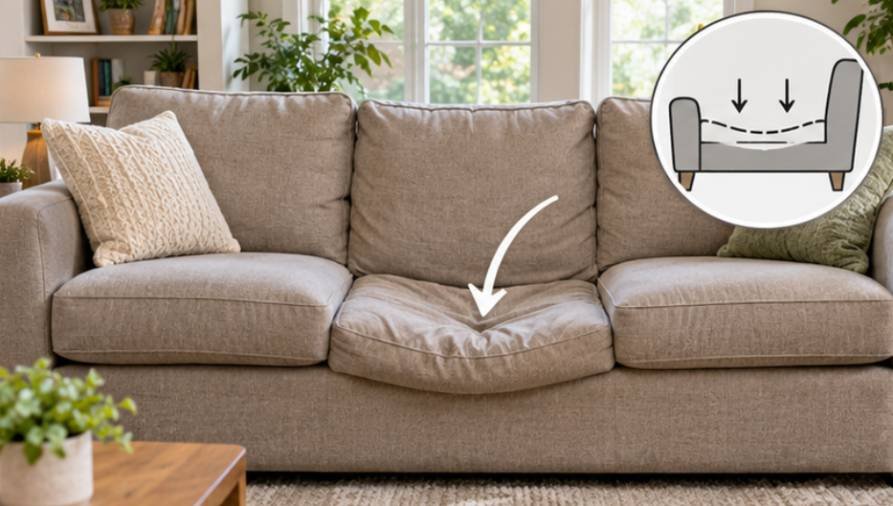
A sinking couch does not always mean you need new furniture. Sometimes, a single plywood board or a fresh foam insert can restore the comfort of a sofa that has seen years of daily use. The important part is figuring out what has actually failed.
Learning how to fix a sagging couch cushion with plywood or foam starts with distinguishing between weakened seat support and worn-out cushioning. Plywood reinforces the structure underneath, while upholstery foam restores the cushion itself. Choosing correctly can save money, improve comfort, and extend your couch’s useful life.
Why Couch Cushions Start Sagging
Most sofas develop uneven seating because their cushions or internal support systems gradually deteriorate.
Just as worn upholstery affects furniture comfort, gaps beneath exterior doors can affect indoor comfort, making it useful to understand how to stop door drafts with simple weatherstripping and threshold repairs.
Polyurethane foam compresses repeatedly under body weight. Over time, lower-quality foam may lose its original thickness and resilience, creating uncomfortable impressions.
The Polyurethane Foam Association explains that foam density influences durability and that higher-density materials generally maintain their properties longer.
However, cushioning is not always responsible. Loose webbing, stretched springs, cracked wooden supports, or damaged seating platforms can also cause sinking.
A couch with healthy cushions but weakened support underneath may feel just as uncomfortable as one with completely flattened foam.
Furniture condition is only one part of indoor comfort; homeowners can also explore thermal curtains for winter warmth to help retain indoor heat and reduce heat loss through windows.
Find the Real Problem Before Buying Materials
A simple inspection can reveal whether plywood, foam, or professional repairs are necessary.
Test the Cushion Separately
Remove the seat cushion and place it on a firm, level floor.
Press down firmly in the center. If the cushion compresses excessively, remains flattened, or fails to recover its shape, the foam may need replacing.
Next, sit on the cushion while it rests on the floor. If it feels considerably better than it does on the couch, inspect the support system underneath.
Inspect the Seating Foundation
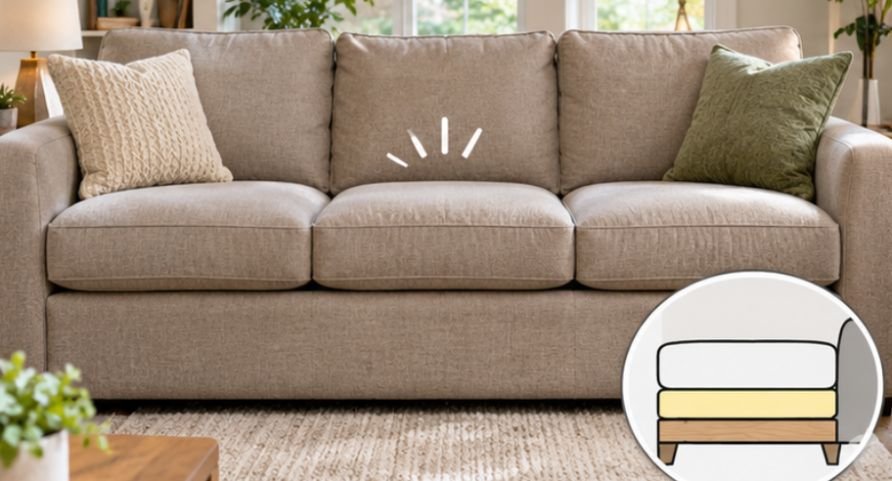
With the cushions removed, examine the springs, webbing, wooden slats, and upholstery platform.
Gently press the seating surface to identify weak sections.
If the support sinks unusually far or produces cracking sounds, structural deterioration may be responsible.
Broken wooden members or sharp, detached springs require proper repairs rather than simply covering them with plywood.
How to Repair a Sagging Couch With Plywood
A plywood insert provides a firmer seating foundation by distributing weight across the underlying structure.
This technique works best when the couch frame remains sound but the seating deck lacks adequate support.
Step 1: Measure the Seating Area
Remove every seat cushion and measure the usable width and depth inside the couch frame.
For example, if the available seating platform measures 72 inches wide and 23 inches deep, a board approximately 71¾ inches by 22¾ inches may provide suitable clearance.
Allowing about one-quarter inch prevents the plywood from scraping against surrounding upholstery. Adjust the dimensions to accommodate curved arms, brackets, or unusual frame shapes.
Step 2: Select Appropriate Plywood
Half-inch plywood can work for some conventional residential couches, provided the board receives adequate support underneath.
Three-quarter-inch plywood offers greater stiffness and may be preferable for wider spans.
However, thickness alone does not establish safe weight capacity. The board’s span, plywood grade, underlying supports, and overall frame condition determine whether it can carry the load.
Choose a smooth, flat panel without cracks or significant warping.
For applicable decorative hardwood plywood, check the EPA’s formaldehyde emission standards for composite wood products. Structural plywood is generally exempt from these particular standards.
Step 3: Cut and Smooth the Board
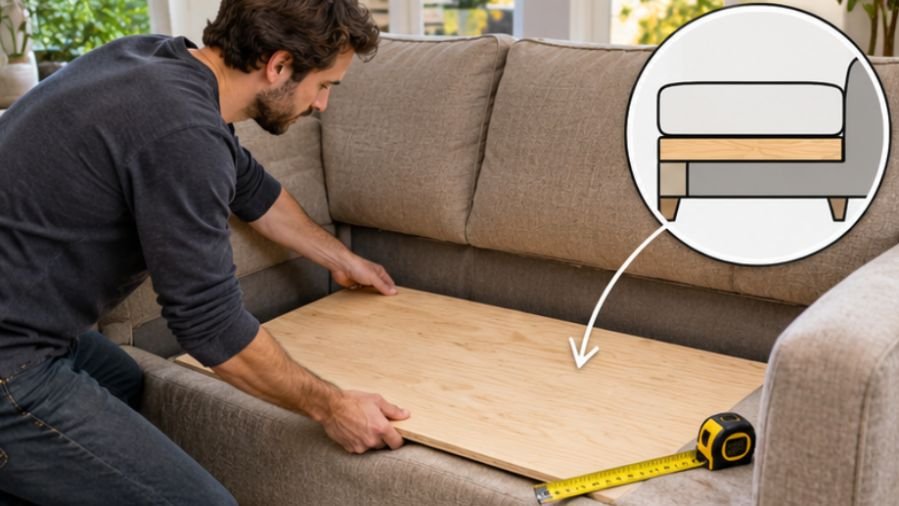
Ask a local hardware store to cut the plywood to your measurements, or use an appropriate saw if you have woodworking experience.
A circular saw works well for straight cuts, while a jigsaw accommodates irregular corners.
Sand the edges using 80- to 120-grit sandpaper, followed by finer sanding where necessary.
The Occupational Safety and Health Administration emphasizes proper blade guarding and precautions against kickback in its circular saw safety guidance.
Step 4: Protect the Upholstery and Install
Wrap the plywood in felt, thin batting, or durable fabric to reduce friction against the seating material.
Position the covered panel directly beneath the cushions, ensuring it rests securely on suitable structural supports.
Replace the cushions and test the seat gradually.
The couch should feel firmer without creating uncomfortable pressure points. If the board rocks, bends excessively, or creates unusual noises, remove it and reassess the underlying structure.
How to Restore Flattened Cushions With Foam
Foam replacement is generally the better solution when the seating foundation remains stable but cushions have lost their shape.
Unlike plywood, appropriately selected foam restores cushioning without turning the seat into an excessively rigid surface.
Step 1: Remove and Measure the Existing Insert
Open the cushion zipper carefully and remove the old foam.
Measure the length, width, and thickness, recording the dimensions in inches.
If the cushion has become heavily compressed, use the inside dimensions of the cover and its original shape to estimate the correct replacement size.
Avoid assuming the flattened insert reflects its original thickness.
Step 2: Choose Foam for Long-Term Comfort
For everyday seating, consider upholstery foam with a density around 1.8 to 2.5 pounds per cubic foot.
The Polyurethane Foam Association’s furniture research identifies 1.8 pounds per cubic foot or higher as a useful durability benchmark for conventional polyurethane seating foam.
Density should not be confused with firmness. A dense foam can still feel soft, depending on its indentation force deflection rating.
Look for foam that offers both adequate durability and your preferred seating firmness.
Products marketed as Lux foam or high-resilience upholstery foam may be suitable, but compare actual specifications rather than relying on product names.
Step 3: Cut and Wrap the Replacement
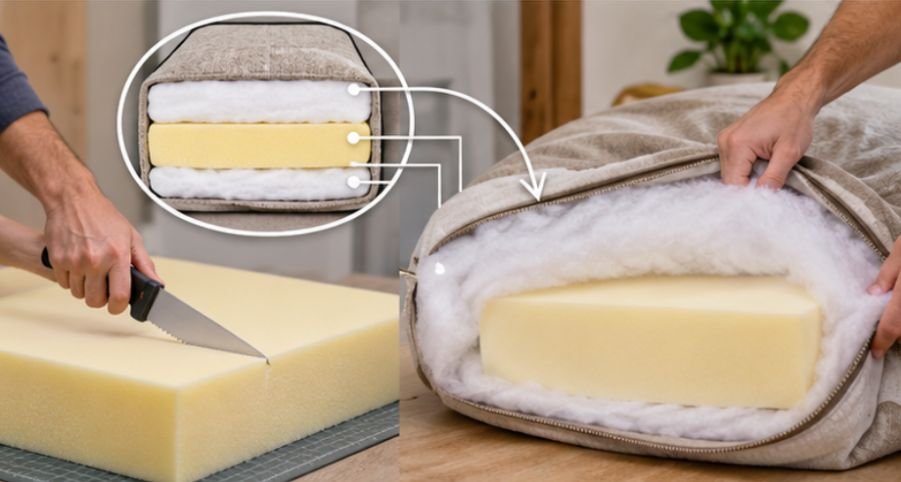
Mark the required dimensions on the foam using a straightedge.
An electric carving knife or long serrated bread knife can produce reasonably clean cuts. Use gentle sawing movements rather than forcing the blade downward.
Wrap the foam in polyester batting, commonly called Dacron, to soften its edges and create a fuller appearance.
Use only enough batting to fill the cushion smoothly without overstretching the cover.
Step 4: Reassemble and Test
Compress the foam slightly and guide it into the cushion cover.
Make sure the corners align before closing the zipper.
Sit in several positions to check comfort and support.
If the cushion feels too firm, reconsider the foam’s firmness specification rather than immediately cutting away large sections.
Frequently Asked Questions
1. Can plywood permanently fix a sagging couch?
Plywood can provide lasting reinforcement when the underlying frame is stable. However, it cannot restore damaged springs, repair broken structural components, or replace deteriorated cushion foam.
2. What thickness of plywood works best under couch cushions?
Half-inch plywood may suit well-supported seating platforms. Three-quarter-inch plywood offers more stiffness, but suitability depends on the span, frame design, and load rather than thickness alone.
3. Is high-density foam better than memory foam for couches?
High-density conventional upholstery foam often provides more responsive seating. Memory foam compresses more slowly and may feel less supportive unless combined with a suitable structural foam core.
4. Can I repair a couch without removing the cushion covers?
You can reinforce the foundation underneath removable cushions without opening their covers. However, replacing internal foam generally requires opening the upholstery or professional assistance.
Final Thoughts
A sagging couch is often a repairable problem rather than a reason to replace furniture. The real challenge is identifying whether the weakness lies inside the cushions or underneath them.
Beyond restoring furniture comfort, homeowners can improve the appearance of their interiors with practical dark hallway lighting ideas that make narrow, poorly lit spaces feel brighter without natural light.
If the seating platform needs additional support, properly fitted plywood may improve firmness. When the cushions have lost their resilience, quality upholstery foam provides a more comfortable solution.
Start by examining the couch, measuring carefully, and choosing materials suited to its construction. Avoid covering up serious structural damage, and remember that better support does not always mean harder seating.
A thoughtful repair can make an aging sofa comfortable again without the expense of buying a replacement.