

One of the most dangerous signs for a new business is not having competitors. It can mean you discovered an untouched opportunity—but it can also mean there is little proven demand.
That is why learning how to research competitors before starting a business matters before you spend heavily on inventory, leases, advertising, equipment, or employees. Competitive research is not about copying successful companies. It is about discovering what customers already pay for, where existing businesses disappoint them, and whether your idea has enough room to compete.
The U.S. Small Business Administration recommends combining market research with competitive analysis because customer demand and competition must be understood together.
Start by Defining What Customers Are Actually Buying
Entrepreneurs often define competitors too narrowly.
Suppose you want to open a meal-prep company. Other meal-prep services are obvious competitors. But grocery-store prepared meals, restaurant delivery, frozen dinners, and meal-kit subscriptions can all compete for the same customer problem: getting dinner without spending much time cooking.
That creates two useful categories.
Direct competitors
These companies sell roughly the same solution to roughly the same customers.
A residential lawn-care company, for example, should examine other local lawn-care providers targeting homeowners.
Indirect competitors
These companies solve the same underlying problem differently.
The lawn-care company might indirectly compete with landscaping marketplaces, robotic lawn mowers, neighborhood teenagers offering mowing services, or homeowners doing the work themselves.
The SBA specifically recommends examining both direct and secondary competitors rather than treating competition as businesses with identical products.
Build a Shortlist You Can Actually Study

Do not collect 50 company names and mistake that for research.
For most startups, five to ten meaningful competitors provide a clearer picture. The U.S. Chamber of Commerce similarly recommends narrowing the analysis to a manageable group of direct competitors rather than drowning in information.
Search Google using the terms customers would probably type, not merely industry terminology. Include location-based searches if you will operate locally.
Also check directories, maps, marketplaces, industry associations, social platforms, and customer review sites.
For a physical business, investigate the surrounding market rather than relying entirely on Google rankings.
The U.S. Census Bureau offers particularly useful free data like small-business research tools. Its Census Business Builder and County Business Patterns resources can help entrepreneurs estimate how many establishments in a particular industry operate within an area and compare demographic and economic characteristics.
Research the Customer Experience, Not Just the Product
A competitor’s homepage rarely tells you why customers choose it.
Act like a prospective buyer.
Visit the website from a phone. Request a quote. Look for appointment availability. Add an item to the cart. Examine delivery costs, cancellation policies, warranties, financing, guarantees and return rules. If practical, buy something.
SCORE recommends first-hand observation for location-based businesses because elements such as service quality, atmosphere and the buying experience may reveal advantages that websites cannot. Ask one question repeatedly:
Where does buying from this company create friction?
A competitor may have excellent products but slow quotes. Another may be inexpensive but difficult to contact. A restaurant might have great reviews but poor parking. Those small frustrations can become positioning opportunities.
Compare the Entire Price, Not the Headline Number
Price research frequently goes wrong because founders compare sticker prices rather than what customers actually pay.
Record:
| Factor | What to investigate |
| Base price | Starting or advertised price |
| Required extras | Setup, delivery, service or installation fees |
| Packages | Basic, premium and bundled options |
| Discounts | Introductory, seasonal or volume offers |
| Contract terms | Monthly, annual or minimum commitment |
| Risk reducers | Returns, trials, guarantees and warranties |
This distinction matters because pricing itself shapes customer expectations.
FTC guidance emphasizes accurate price representations, advertising guidance for small businesses and warns businesses that price comparisons and sale claims must be truthful.
Your goal is not automatically to become cheaper. Sometimes competitor research shows that customers will pay more for faster service, easier scheduling, better support, higher quality, greater convenience or simpler pricing.
Use these competitive insights to establish a sustainable pricing strategy by learning how to price a product for a small business, balancing customer expectations, competitor rates, operating costs, and your desired profit margins.
Study What Competitors Promise
Next, forget product specifications for a moment and study language.
Write down the main promise on each competitor’s homepage or advertising.
One accounting firm may sell “affordable bookkeeping.” Another sells “more time to run your business.” A third focuses on reducing tax-season stress.
They provide similar services but position them differently.
Review:
Search visibility
Search important customer queries and note which companies appear repeatedly in organic results, map listings and advertisements.
Content
Look at guides, videos, email newsletters, social posts, FAQs and educational resources.
Do not simply count posts. Identify what customers respond to.
Positioning
Ask who the competitor appears designed for.
Budget shoppers? Families? Professionals? Luxury buyers? Beginners? Large companies?
You may discover that the market contains plenty of businesses but surprisingly few speaking directly to one valuable customer group.
Turn Reviews Into a Free Customer Research Database
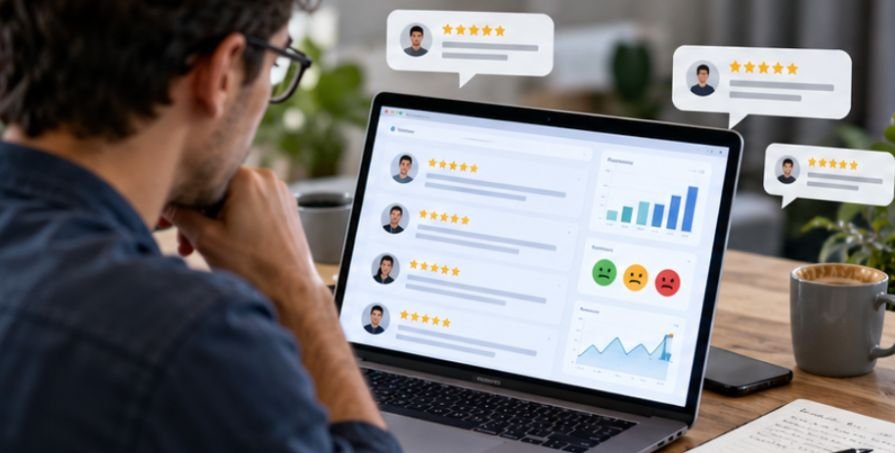
Reviews are often more revealing than competitor marketing. Start with recent Google reviews and, where relevant, Yelp, marketplace reviews, Better Business Bureau information, industry forums or specialist platforms. Do not obsess over whether a company has 4.4 or 4.7 stars. Look for repeated language.
If dozens of customers repeatedly mention slow communication, confusing billing, appointment delays or poor packaging, you may have found a structural weakness.
Positive reviews matter just as much. They reveal what customers refuse to sacrifice.
Once you understand what customers value and where competing businesses fall short, use those insights to shape your outreach strategy and learn how to get your first customers for a new business by addressing unmet needs with a clear, differentiated offer.
If customers constantly praise one competitor’s same-day response time, entering the market with slower service could be difficult regardless of how attractive your product looks.
The FTC also stresses the importance of genuine consumer reviews and has specific guidance aimed at maintaining truthful review practices.
Add Market Data Before Declaring There Is a “Gap”
A common startup mistake is assuming that weak competitors automatically equal a strong opportunity.
Sometimes businesses provide limited service because customers simply will not pay enough to support anything better.
Combine your qualitative observations with numbers.
Check local population, income, household composition, industry concentration, consumer spending indicators and employment trends.
Bureau of Labor Statistics data can also provide useful information about employment, wages and industries when staffing costs or labor availability affect your business model. BLS notes that businesses increasingly use market research and large datasets, including customer reviews and social information, to understand purchasing behavior and demand.
Finish With a SWOT—but Make It Evidence-Based

SWOT analysis becomes useful only after research.
List competitor strengths you must overcome, weaknesses you can exploit, opportunities created by customer or market changes, and threats that could prevent profitable entry.
The SBA specifically recommends studying market share, strengths and weaknesses, barriers to entry, indirect competitors and the window of opportunity available to a new business.
Use the SBA’s business-planning resources.
Avoid writing vague items such as “strong competition.”
Write something actionable instead: “Three established providers have hundreds of reviews and dominate local search.”
That tells you what problem must actually be solved.
Before acting on the opportunities identified in your analysis, verify the legal requirements for entering your chosen market by reviewing what licenses you need to start a business, including any industry-specific permits or local approvals that could affect your ability to compete.
Frequently Asked Questions
1. How many competitors should I research before starting a business?
Five to ten meaningful competitors are usually enough for a useful initial analysis. Include both direct competitors and alternative solutions customers might choose instead.
2. Can I research competitors for free?
Yes. Google, customer reviews, social platforms, Census data, government databases, competitor websites and in-person observation can provide substantial information without paid competitive-intelligence software.
3. What should I look for in competitor reviews?
Look for recurring complaints, frequently praised features, pricing concerns, service problems and unmet expectations. Patterns matter more than isolated angry or enthusiastic reviews.
4. How often should competitor research be updated?
Review major competitors before launch, shortly after entering the market and periodically afterward. Update sooner when pricing, technology, customer behavior or major competitors change rapidly.
A Better Business Idea Starts With Evidence
The purpose of how to research competitors before starting a business is not to prove that your original idea was brilliant. It is to give yourself permission to change it before change becomes expensive.
Good competitor research may confirm your concept, uncover a sharper niche, expose unrealistic pricing or persuade you not to enter the market at all. Every one of those outcomes has value.
Before designing the perfect logo or signing a lease, identify several serious competitors and experience their businesses like a customer. The opportunity you eventually pursue should come from what the evidence reveals—not simply from what you hoped would be true.