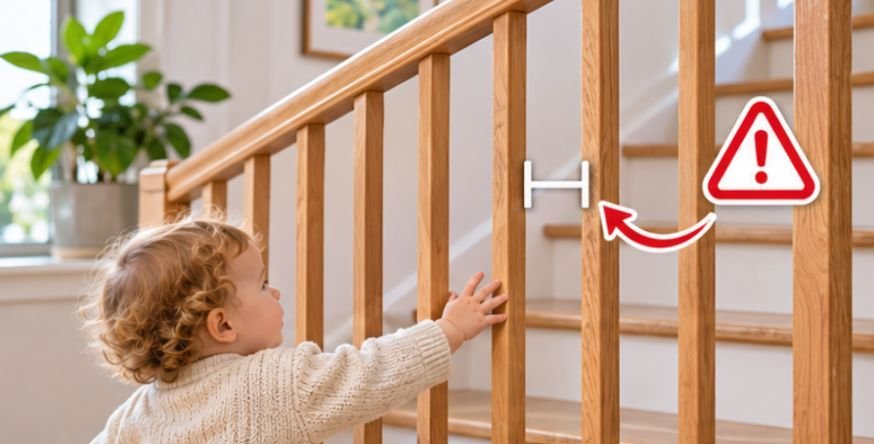
A staircase can look perfectly secure to an adult while hiding dangerous openings for a curious toddler. Wide gaps between railings, unsecured baby gates, and exposed stair edges can turn an ordinary household feature into a serious fall hazard.
Learning how to childproof stairs with open spindles starts with two essential precautions: covering unsafe railing gaps and installing properly anchored safety gates.
The good news? You don’t necessarily need to replace your staircase. From transparent acrylic panels to protective mesh and specialized gate adapters, several practical solutions can make open stair railings safer without sacrificing your home’s appearance.
Why Open Stair Spindles Can Be Dangerous for Children
Open spindles, also called balusters, are the vertical supports connecting a staircase’s handrail to its lower rail or stair treads.
Although these features provide structural support, widely spaced balusters can create openings through which small children might squeeze, fall, or become trapped.
The International Code Council’s residential building code provisions generally apply a 4-inch sphere limitation to guard openings, with specific exceptions for stairways.
These dimensions matter because children can attempt to pass through spaces that appear too narrow for them.
Another concern is climbing. Horizontal decorative elements or poorly positioned protective coverings may unintentionally provide footholds.
According to Nationwide Children’s Hospital, approximately five children younger than seven receive emergency department treatment for baby gate-related injuries daily.
That finding reinforces an important distinction: installing a protective product is only effective when the product is appropriate and correctly secured.
5 Effective Ways to Childproof Open Stair Railings
The best solution depends on your railing material, spindle spacing, type of staircase, and whether you need temporary or permanent protection.
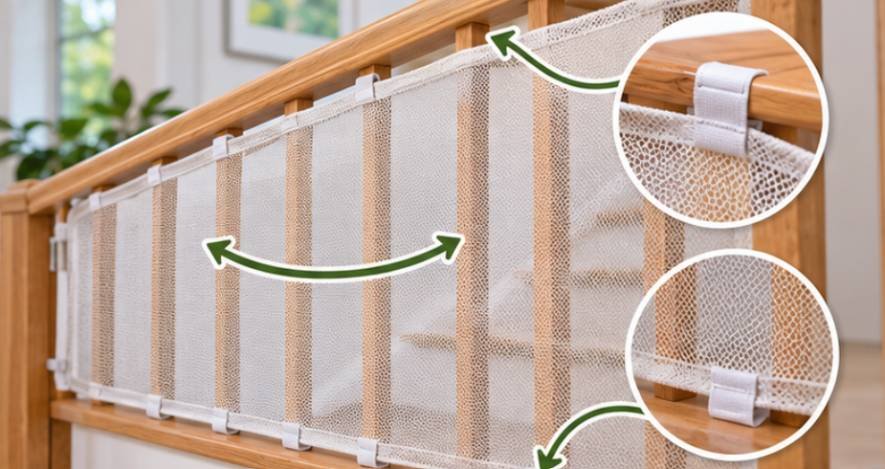
1. Install Heavy-Duty Stair Banister Mesh
Protective mesh is one of the more accessible options for families seeking a removable barrier.
A purpose-made stair banister guard covers gaps between spindles while allowing light and airflow to pass through.
For installation:
- Measure the entire exposed railing section, including its height.
- Select a child-resistant guard intended for stair railings.
- Position the material against the inside of the balusters.
- Secure it according to the manufacturer’s instructions using approved fasteners.
- Check that the upper, lower, and side edges cannot be pulled away.
Avoid ordinary garden netting, loose cord, and materials with openings that could trap fingers or create entanglement hazards.
Mesh should remain tightly secured without dangling straps or accessible fastening loops.
Best for: Families needing a temporary, removable solution.
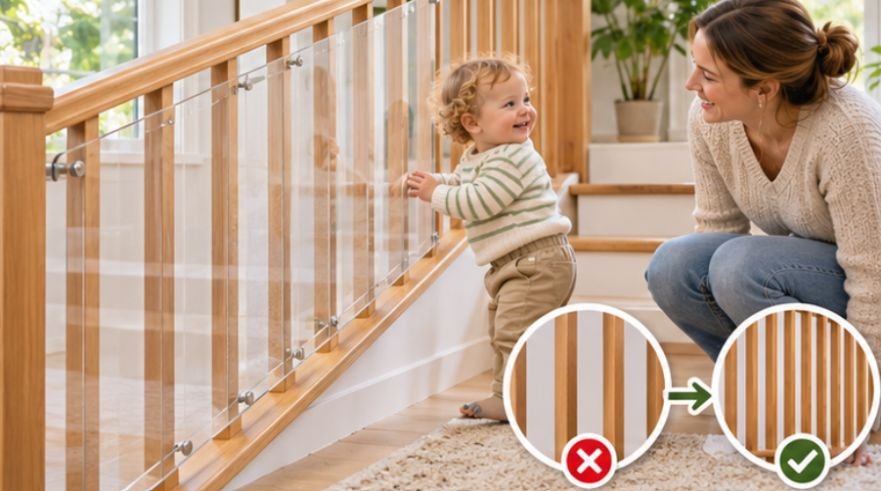
2. Add Clear Acrylic Panels for Better Coverage
Transparent acrylic panels provide a more rigid alternative to flexible mesh.
These protective sheets create a continuous surface across exposed balusters while preserving visibility through the staircase.
They are particularly useful in homes featuring decorative wooden railings or modern metal spindles.
When comparing materials for different home improvement projects, homeowners can also consider the cheapest way to cover a concrete patio for affordable options to upgrade an existing outdoor surface.
Before installation, measure each railing section separately. Staircases with changing angles may require custom-cut panels.
Choose appropriately thick, impact-resistant material with smooth, finished edges.
Panels should be attached using compatible mounting hardware secured to suitable structural components. Do not assume thin spindles can safely support the installation.
Acrylic also requires careful positioning. The top edge must not create a convenient climbing ledge.
Best for: Homeowners wanting a discreet barrier that complements their interior design.
3. Install Hardware-Mounted Safety Gates
Covering spindle gaps does not prevent children from accessing the staircase itself. That requires correctly installed safety gates.
The U.S. Consumer Product Safety Commission recommends childproofing your home with gates that screw into the wall at the top of stairways.
Pressure-mounted gates should never be used at the top because they can become dislodged.
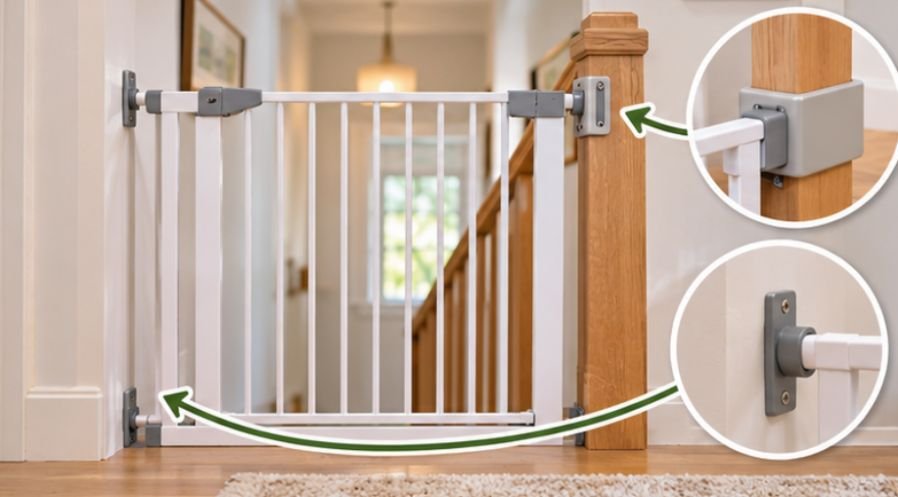
For open railings, look for gate systems compatible with solid newel posts or properly rated banister mounting adapters.
A secure installation should include:
- Hardware-mounted connections at the staircase’s upper entrance.
- Anchors attached to appropriate structural supports.
- A child-resistant locking mechanism.
- A gate designed specifically for stairway use.
- No dangerous threshold or opening beneath the gate.
At the bottom, an appropriately installed child safety gate helps prevent unsupervised climbing.
Best for: Every household with mobile infants or toddlers, regardless of spindle spacing.
4. Use Specialized Banister Gate Adapters
Many staircases lack a convenient wall on both sides of the opening.
This commonly occurs in homes with two opposing banisters or a wall facing a rounded wooden newel post.
Specialized banister adapter kits can provide mounting surfaces without requiring screws directly through decorative railing components.
However, these adapters must be approved for the selected gate and railing configuration.
Never attach a safety gate directly to thin, loose, or fragile individual spindles.
Before purchasing, confirm the adapter supports your post’s dimensions, shape, and finish.
Best for: Stairways with unusual mounting arrangements or finished wooden newel posts.
5. Retrofit Additional Balusters for Permanent Protection
When existing openings are exceptionally wide, adding more vertical balusters may be the most dependable long-term improvement.
A qualified carpenter can evaluate the railing and install appropriately spaced supports.
This approach addresses the underlying opening rather than covering it with temporary material.
For example, a railing with approximately 6-inch clear openings may require additional balusters or a redesigned layout.
The final spacing must follow applicable local residential building requirements.
Permanent improvements are especially worthwhile when renovating an older house with outdated railing designs.
Homeowners addressing other structural issues in older homes may also find it useful to learn how to fix squeaky hardwood floors under carpet without removing the existing floor covering.
Best for: Homeowners seeking durable, integrated protection.
How to Measure Your Staircase Before Buying Childproofing Materials
Accurate measurements help prevent wasted purchases and poorly fitted barriers.
Start by examining every section of the staircase rather than measuring a single opening.
Step 1: Check the Clear Spindle Spacing
Use a tape measure to determine the actual open distance between adjacent balusters.
For an initial safety screening, use the 4-inch sphere guideline, but remember that some stair-specific code exceptions apply.
Step 2: Examine Open Risers
Some contemporary staircases have no vertical backing between individual steps. These openings present an additional hazard that railing guards cannot solve.
The International Residential Code includes specific opening restrictions for qualifying open-riser stairways.
Consult a qualified contractor if the gaps between steps appear large enough for a child to pass through.
Step 3: Inspect the Landing and Gate Locations
Measure the width between reliable mounting surfaces at both ends of the staircase.
Check for uneven trim, rounded posts, angled walls, and nearby doors that could interfere with gate operation.
Step 4: Test the Finished Installation
After fitting each barrier, inspect it for loose fasteners, sharp edges, accessible cords, and openings around its perimeter.
Do not test its strength by allowing a child to climb or push against it.
Common Stair Childproofing Mistakes to Avoid
Some inexpensive fixes create new hazards rather than eliminating existing ones.
Using a Pressure-Mounted Gate Upstairs
Pressure-mounted gates rely on friction and can shift under force.
Reserve them for suitable locations where the manufacturer permits their use, never the top of stairs.
Relying on Decorative Netting
Decorative rope barriers and lightweight netting are not necessarily designed for child safety.
Only use materials appropriate for the intended protective function.
Creating Climbing Opportunities
Loose protective sheets, horizontal supports, and nearby furniture can make railings easier to climb.
Avoid arrangements that give children additional footholds.
Assuming Supervision Makes Gates Unnecessary
The American Academy of Pediatrics recommends sturdy gates at both ends of staircases as babies become mobile.
Even children who have learned to navigate stairs need continued supervision and protection.
Frequently Asked Questions
1. How to childproof stairs with open spindles without drilling?
Use a purpose-made banister guard or compatible no-drill railing adapter. However, top-of-stairs gates still require approved hardware mounting to secure structural supports.
2. What is the safest material for covering stair spindles?
Properly secured rigid panels offer continuous coverage. Child-resistant mesh may also work, provided it is designed for railing protection and installed correctly.
3. Are stair spindle gaps larger than 4 inches unsafe?
They deserve closer evaluation. Residential codes commonly use a 4-inch sphere standard, although certain stair openings have exceptions. Check local requirements and address potential child-access hazards.
4. When should parents remove stair safety gates?
Consider removing or reassessing gates when children can open or climb over them, often around age two. The child’s development and household circumstances should guide the decision.
A Safer Staircase Starts With the Right Barrier
Childproofing open stair railings is not about covering every visible gap with the nearest available material. It is about understanding where children might fall, become trapped, or gain access to a staircase without supervision.
For most families, the strongest approach combines securely mounted stair gates with appropriately designed spindle protection. Mesh and acrylic panels offer practical retrofit options, while additional balusters provide a more permanent improvement.
I recommend beginning with a careful staircase inspection before purchasing anything. Measure the openings, check the mounting surfaces, and prioritize structural security over appearance. A well-chosen barrier should protect children without creating another hazard.